In service-based companies, the main asset is not a physical product, but rather the knowledge, time, and expertise of the team. Whether it is a consultancy, a maintenance provider, a software development company, or a professional services firm, the efficient management of projects, human resources, and invoicing is essential to ensure profitability, compliance, and client satisfaction.
In this context, an ERP (Enterprise Resource Planning) system specialised for service providers becomes a strategic tool. It is not only about automating accounting tasks, but also about coordinating teams, anticipating workloads, meeting deadlines, and managing contracts with precision.
This article explores how a service-focused ERP can help you take full control of your operations and scale your business efficiently.
Key benefits of an ERP for Service Companies
1. Integrated Project Management
A modern ERP allows you to plan, allocate, and monitor tasks from a single platform. Service companies often manage multiple projects simultaneously, involving different teams, budgets, and deadlines. A system such as K2B ERP helps to:
-
View the status of each project in real time.
-
Assign responsibilities, set milestones, and track progress.
-
Estimate costs and profitability from the outset.
This visibility enables managers to make better-informed decisions and anticipate budget deviations or operational bottlenecks.
2. Time and Human Resources control
One of the greatest challenges in the services sector is managing staff time effectively. A specialised ERP allows you to:
-
Record hours worked by project or client.
-
View the workload of each resource.
-
Automate approvals for timesheets and absences.
This level of control not only facilitates balanced work allocation, but also enables accurate invoicing based on the actual effort delivered.
3. Automated invoicing and contract management
Many service companies invoice based on hours worked, recurring services, or deliverable milestones. With an ERP such as K2B, you can:
-
Automatically generate invoices according to the contract and recorded time.
-
Manage recurring billing without errors.
-
Monitor compliance with service-level agreements (SLAs).
In addition, integration with accounting systems allows for automatic reconciliation, improving the financial health of the business.
4. Profitability tracking by project or client
Unlike other sectors, in services it is crucial to know how profitable each contract or client is. A well-implemented ERP allows you to:
-
Associate revenue, direct costs, and indirect costs with each project.
-
Automatically calculate margins.
-
Identify which clients or services generate the most value.
This information helps redefine commercial strategies and optimise the client portfolio.
The strategic role of ERP in Service Companies
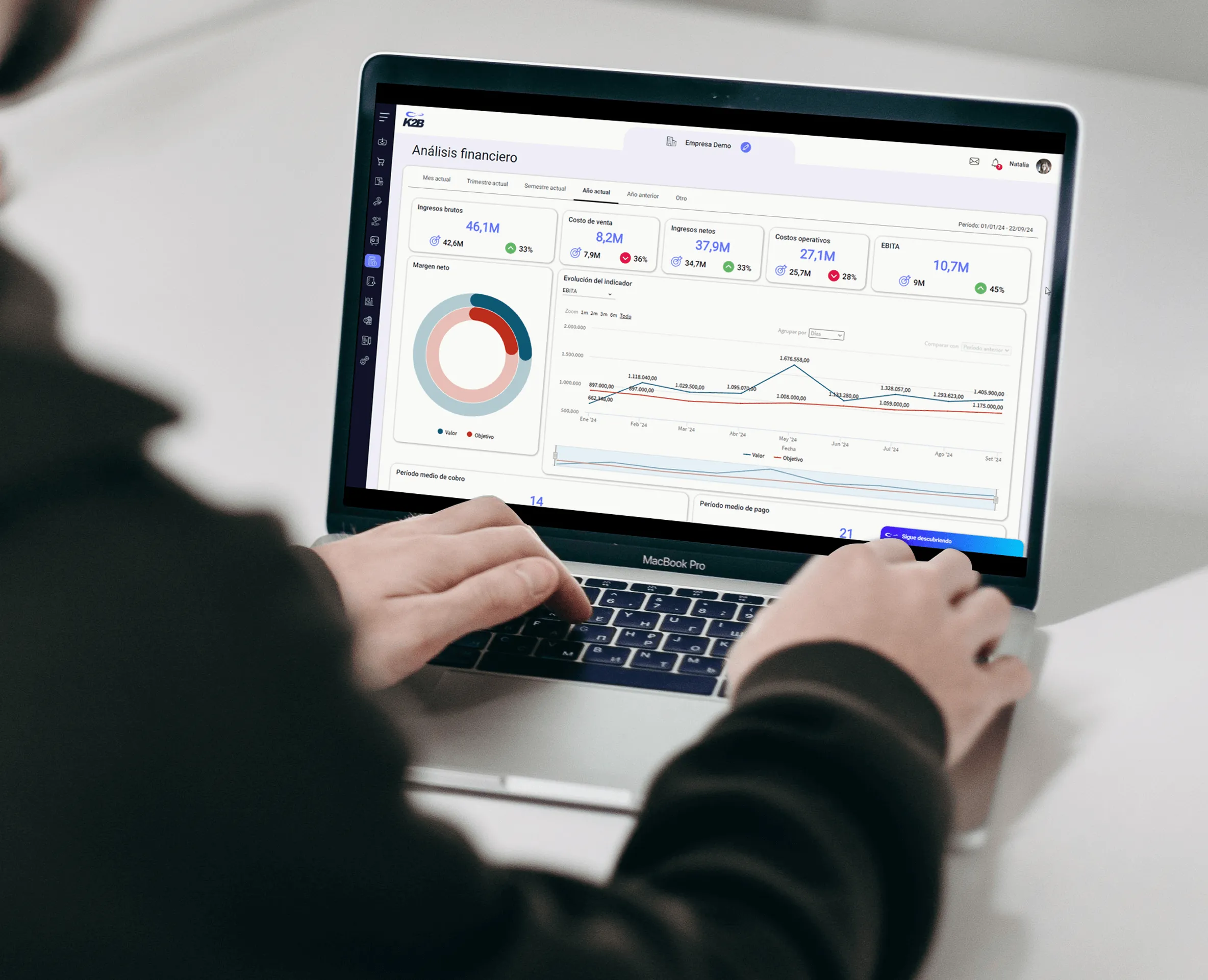
Management in a service company is highly dynamic: new projects are constantly being launched, teams are reassigned, and priorities shift in line with client demand. Without an integrated solution, processes become fragmented, valuable data is lost, and the risk of errors increases.
Implementing an ERP such as K2B allows you to integrate key areas, including:
-
Project and operations management
-
Human resources
-
Finance and accounting
-
Sales and contracts
-
Customer service and after-sales support
By centralising information and automating processes, efficiency improves, rework is reduced, and the quality of the service delivered increases.
Considerations when implementing an ERP in Service Companies
Scalability
Choose a system that can grow with your business, allowing you to add new services, users, or locations.
User Experience
Your team should be able to adopt the tool easily. A user-friendly interface and proper training are key to success.
Integration
Your ERP should integrate seamlessly with tools such as CRM, document management systems, and internal communication platforms.
Local Support
A technology partner such as K2B, with experience in the Latin American market, can facilitate an agile and effective implementation.
Professionals driving business success
An ERP is not a luxury for service companies — it is a necessity for scaling, controlling, and growing without compromising quality. With specific tools such as project management, time tracking, automated invoicing, and profitability analysis, your business can take a significant qualitative leap.
Would you like to see it in action? Request a K2B ERP demo and discover how to transform the management of your service company.
FAQ
1. What makes a service ERP different from a traditional one?
A service ERP is designed for projects, people, and contracts rather than products. It prioritises time tracking, milestone-based invoicing, and profitability monitoring by client.
2. Can I use an ERP if my company is small?
Yes. K2B ERP is designed to scale from small firms to large organisations, adapting to each company’s size and complexity.
3. How long does it take to implement a service ERP?
It depends on the size and complexity of the business, but with a specialised team and clear processes, you can begin operating within a few months.
4. What types of companies benefit most?
Consultancies, professional practices (lawyers/accountants), maintenance companies, IT, design, engineering, education, and more — essentially, any business where the “service” is its main product.