An intelligent ERP is a management system that incorporates artificial intelligence agents capable of understanding natural language, carrying out tasks and generating information without the user having to navigate menus. This is the evolution that K2B presented in its webinar “ERP and AI Agents: the new generation in business management”, delivered by Rafael Mon, CEO of K2B. Below, we summarise what is changing, how it works, and what organisations already using a management system like K2B can expect.
From ChatGPT to agents: how AI applied to business management has evolved
In November 2022, the launch of the ChatGPT chat democratised access to artificial intelligence. For the first time, anyone could type a question in natural language and receive a coherent answer, without relying on research centres or universities.
From that point on, the technology progressed through three concrete stages:
1.Assistants with structured prompts. Tools emerged to define and reuse prompts, improving the quality of AI responses.
2.RAG (semantic indexing). This made it possible to attach an organisation’s own content to language models in order to obtain more precise answers.
3.Proactive agents. AI stopped merely answering questions and began planning and carrying out complete tasks within a management system.
This third stage is the one K2B has built into its ERP: agents that do not just provide information, but act directly on the purchasing, finance and CRM modules.
Intent Based Navigation: querying the management system in natural language
Intent Based Navigation is the K2B feature that replaces menu-based navigation with a direct question. Instead of telling the system which screen to open, the user states the result they want, and the intelligent ERP works out how to get there.
A real example shown during the webinar: when asked “what were this week’s receipts?”, K2B interprets this as referring to income-type fund movements, filters only those that are reconciled and executed, and displays the last seven days, all without the user opening a single menu. The paradigm shift is total: previously, the system was told what to do step by step; now, it is told what outcome is wanted, and the artificial intelligence works out the route.
AI agents in action: from a purchase request to a financial dashboard
K2B’s agents, due to launch this year in the next version, are already working in demos on real processes within a management system powered by artificial intelligence. These are the three examples shown live during the webinar.
- Purchase requests via chat. The user types “I want to buy mineral water” and the agent asks, in natural language, which format, what quantity, for which physical location and by what delivery date, until the request is loaded into K2B. The user can even change their mind partway through the conversation (for example, going from 60 to 80 bottles) and the agent adjusts the request without restarting the process.
- Prompt-generated dashboards. With a single prompt describing what is needed, K2B generates a financial dashboard and automatically cross-references it with up-to-date accounting information.
- AI-assisted bank reconciliations. The system uses AI to identify matches between bank statements and recorded transactions, including cases that previously could not be mapped directly, increasing the automatic reconciliation rate.
K2B is also developing an expenses management agent, which will allow users to upload a photo of an invoice and log the expense simply by chatting with the agent.
An open architecture: why an AI-powered management system needs to integrate
K2B splits its architecture into a business layer (the processes and information the ERP already manages) and a service layer exposed through open standards. This separation is what allows K2B to connect with external AI-assisted development tools, such as Codex or other vibe coding solutions.
In practice, this does not mean programming inside K2B itself, but rather building external components with these tools and integrating them with the management system through that service layer. This allows K2B’s ecosystem to expand without relying solely on the in-house development team.
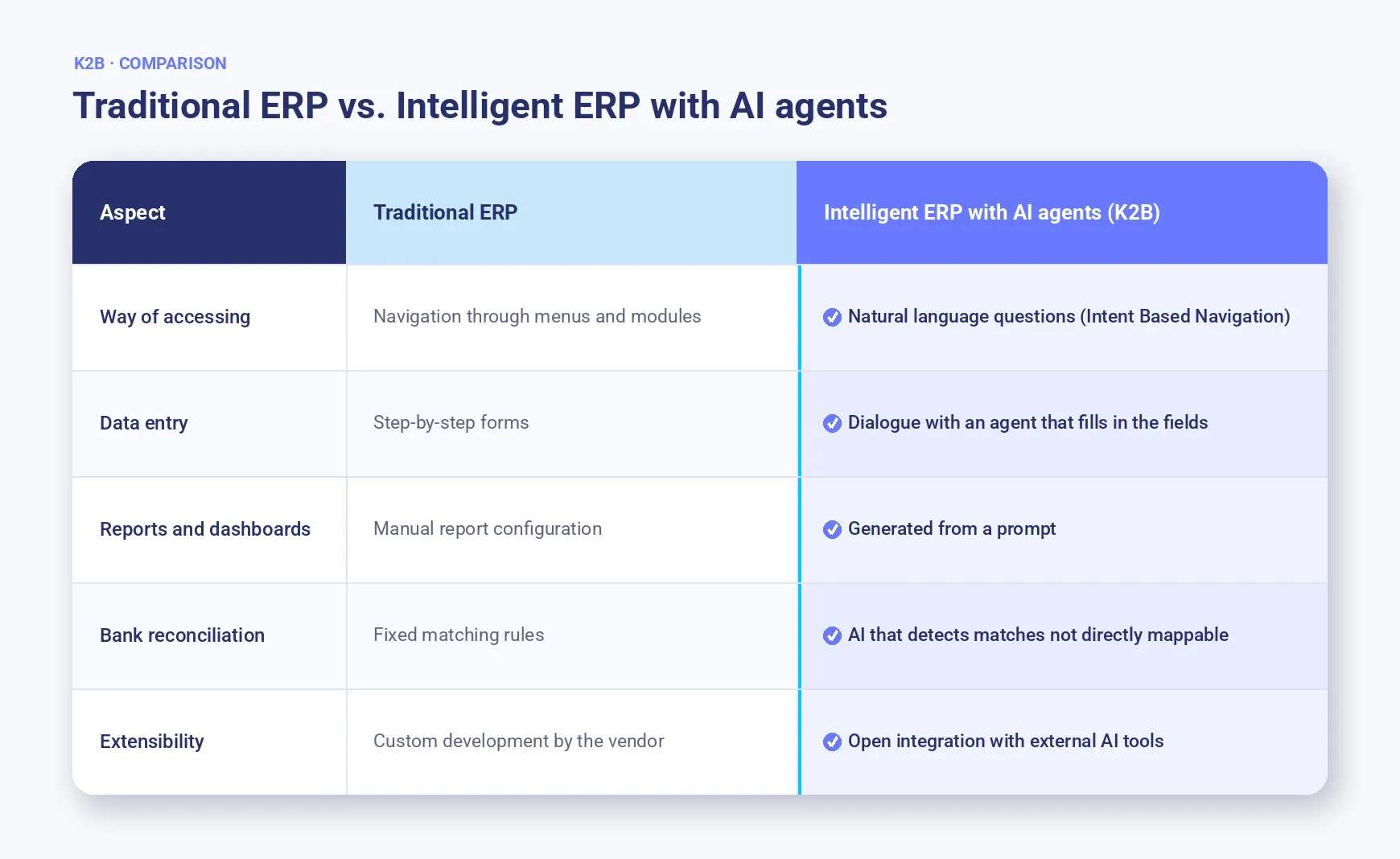
Traditional ERP vs. intelligent ERP with AI agents
The table below summarises the main differences between a traditional ERP and an intelligent ERP with AI agents such as K2B.
Frequently asked questions about AI agents in K2B
Do K2B’s agents allow programming inside the management system? No. The agents are not designed for programming inside K2B. What they do allow is developing components with external AI tools (such as Codex) and integrating them with K2B through its open service layer.
Which version of K2B will the AI agents be available in? The agents will be released in the next version of K2B, following the current Infinia version, which the team is currently finishing up.
Do AI-generated dashboards update themselves? Yes. Once a dashboard has been generated from a prompt, K2B cross-references it with accounting information and keeps it up to date according to the period being queried.
Which areas do K2B’s agents currently cover? Today, the agents are geared towards tasks used frequently by most users within a company, such as purchase requests, receipt enquiries and bank reconciliations. K2B is working on extending this capability to supply chain and sales forecasting.
Conclusion: the intelligent ERP arrives at K2B this year
The intelligent ERP is no longer a future promise but a concrete feature: K2B is launching AI agents this year, in its next version, capable of carrying out real purchasing, finance and reconciliation processes. The key to this shift is that artificial intelligence is moving from answering questions to carrying out complete tasks within the management system, shortening the learning curve and speeding up access to information. For companies already using K2B, the next step is to identify which internal processes — purchasing, expenses, approvals — are best suited to piloting these agents once they become available.
Content based on the webinar “ERP and AI Agents: the new generation in business management”, delivered by the K2B team on 22 July 2026. The full recording is available on request.